Pärnu — Three Lessons in Light with the Estonian Festival Orchestra and Paavo Järvi
By Pierre Jean Tribot – July 12, 2026
"The richness of sound was extraordinary; the collective enthusiasm infectious; the intonation impeccable; the palette of colours astonishing; and the subtlety of dynamic shading simply breathtaking. This is repertoire that fits Paavo Järvi like a glove."
"In short, this was an absolutely unforgettable orchestral performance. And it is worth stating plainly: the Järvi–Estonian Festival Orchestra partnership belongs among those rare artistic collaborations encountered only exceptionally. Here, Järvi has built one of today's finest orchestral standards, rivalled perhaps only by Iván Fischer's Budapest Festival Orchestra—a similarly cohesive artistic vision, comparable technical excellence, and the same extraordinary level of collective commitment. In July, Pärnu has truly become one of the high points of Europe's musical calendar.
The programme on July 11 at the Pärnu Music Festival unfolded like a meditation on light: southern light filtered through Fauré's Symbolist veil; northern light—the kind that, during the Estonian summer, never fully disappears—in the world premiere by Tõnu Kõrvits; and finally, landscape-light, inhabited and almost organic, in Nielsen's Sinfonia espansiva. Three different kinds of radiance, three distinct ways of making an orchestra sing.
Fauré opened the evening with the Pelléas et Mélisande Suite, a choice that immediately recalled the stylistic mastery Paavo Järvi has demonstrated in his many acclaimed recordings of the French repertoire. His was a clarity of expression that refused opacity, with sculpted phrasing never giving way to ornamentation. The sunlit Sicilienne never overwhelmed the Symbolist twilight of the Prélude and The Death of Mélisande. The Spinning Song flowed effortlessly, carried by the exquisite legato of the woodwinds, a performance worth the journey on its own.
The evening's first major highlight came with the world premiere of Tõnu Kõrvits's Viola Concerto, Secret Garden, written for Amihai Grosz. Kõrvits once again confirmed his distinctive gift for musical storytelling: a narrative that unfolds through sublime exchanges between the solo viola and an orchestra employed with remarkable economy of means, revealing an infinite palette of nuance and orchestration of astonishing mastery. The concerto opens with a dialogue between the viola and timpani and closes with that same exchange, completing a dramatic arc of rare inevitability. With the exception of the central movement, Song of the Light, the full orchestral forces are seldom heard together. Instead, Kõrvits favours finely judged chamber-like combinations—three clarinets, horn, oboe, bassoon, restrained percussion—in which every instrumental colour serves a narrative purpose. Beneath this restraint lies genuine melodic beauty, supported by orchestral craftsmanship that gives this concerto every quality needed to become a major addition to the still relatively limited viola concerto repertoire.
Amihai Grosz, for his part, was simply magnificent: inwardly focused, projecting effortlessly, and in constant dialogue with the conductor. As an encore, he offered a welcome moment of contemplative elevation with the Prelude from Bach's First Cello Suite, in a transcription for viola.
The second half, however, delivered the evening's true revelation. Already outstanding in Fauré and Kõrvits, the Estonian Festival Orchestra displayed its full stature in Nielsen's Sinfonia espansiva. The richness of sound was extraordinary; the collective enthusiasm infectious; the intonation impeccable; the palette of colours astonishing; and the subtlety of dynamic shading simply breathtaking. This is repertoire that fits Paavo Järvi like a glove. His conducting technique allows him to shape the orchestral layers with exceptional precision, bringing hidden details to the surface while mastering this magnificent orchestral body so that every texture and every contrapuntal line remains perfectly clear. The Andante pastorale transformed the symphony into a living open-air landscape, with Sandra Laagus and Tamar Nugis introducing the human voice as a tangible presence within nature itself. As an encore came Hugo Alfvén's beautiful Elegia, whose poetic refinement evoked the shimmering summer light on the sea and the Nordic forests.
In short, this was an absolutely unforgettable orchestral performance. And it is worth stating plainly: the Järvi–Estonian Festival Orchestra partnership belongs among those rare artistic collaborations encountered only exceptionally. Here, Järvi has built one of today's finest orchestral standards, rivalled perhaps only by Iván Fischer's Budapest Festival Orchestra—a similarly cohesive artistic vision, comparable technical excellence, and the same extraordinary level of collective commitment. In July, Pärnu has truly become one of the high points of Europe's musical calendar.
It should also be noted that, before the performance of Nielsen's symphony, Estonian composer Liisa Hirsch was presented with the 2026 Lepo Sumera Composition Prize, awarded on July 11 during the Pärnu Music Festival in recognition of one of the most distinctive voices on Estonia's contemporary music scene.
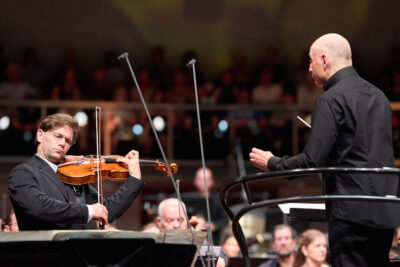
Pärnu Concert Hall, Pärnu – July 11, 2026.
Photo credit: Kaupo Kikkas.


Comments